On the 29th of March, Beyoncé asked the world one question: Can we stand for something? These lyrics are from her opening track, American Requiem, from her latest studio album, Cowboy Carter.
Her question and the message of American Requiem couldn’t come during a more defining time of US history and music history. This year, the world’s attention will once again turn to the US election in November. Two candidates, who couldn’t be more different, compete against each other: Donald Trump vs. Kamala Harris.
American Requiem can be interpreted as an overarching connection regarding the US election, US history, US music history, and what Beyoncé says through her art about all of this. The opening song connects the past, the present, and the stakes of the future, especially when taking a closer look at the title of the song itself.
A requiem is a song that is sung to remember something. Often it is part of a sacred composition or accompanied by a religious text, reminiscing about the past. It’s usually sung at funerals. And this is where things get interesting. Because one thing that has been a clear opinion of conservative and far-right politicians is that the past was always better. Of course, they are wrong, and they are lying. In the past, many things weren’t better. They certainly weren’t better for women, LGBTQ+ rights, or people of colour to name only a few issues.
It’s also true that while some things, especially regarding women’s rights, human rights, etc., improved over the last few decades, a lot of things are still unjust and treated as such. Conservative and far-right politicians remain adamant about lies suiting themselves. They protect their own self-interests and their harnessing of power and wealth while the rights of others, taking the US for example, the rights of women and Afro-Americans are under attack, and in the worst cases, are taken away again.
Beyoncé sums up this issue in the very first line of American Requiem, her funeral song for the US: ‘Nothin’ really ends, for things to stay the same, they have to change again, hello my old friend, you change your name, but not the ways you play pretend, American Requiem, them big ideas, are buried here, Amen.’
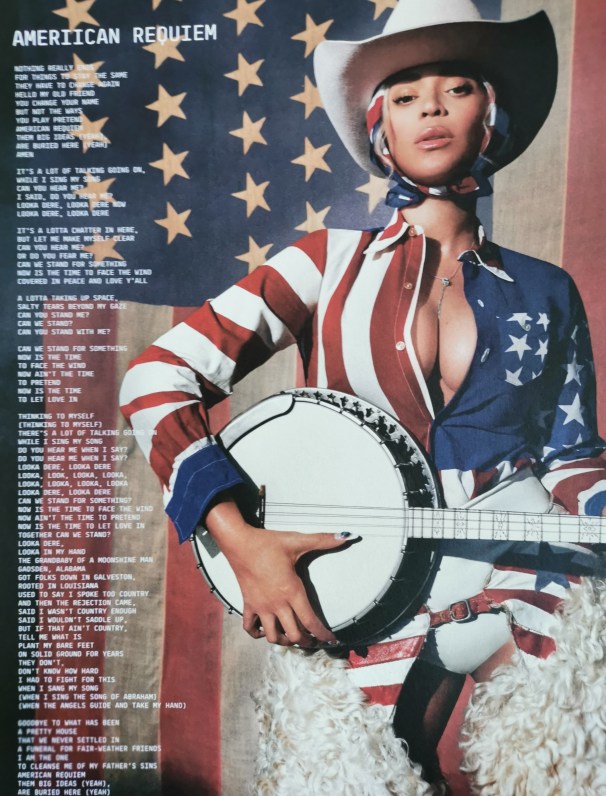
The first lines are more than clear. Racism, marginalisation and other things never really end. The fight will always continue. And the rights that have been fought for have to be protected and, if necessary, must be fought for again.
The following line might be the most interesting one of the first stanza: ‘hello my old friend, you change your name, but not the ways you play pretend.’ It echoes the beginning of the song but almost in an exhausted comedic way. Beyoncé cannot be fooled. She recognises the racist, the sexist, the homophobe. It’s an ‘old friend’, she can immediately identify. He might have changed his name, but she knows how he plays. It’s almost like the saying: When the devil smiles at you, you have to smile right back at him.
The last lines, though, unravel a more uplifting tone. Because she reminds us that this is a funeral song for America. Today’s America and the America of the past are dying, with all its big ideas that are getting buried. And with this new act and new genre, Beyoncé offers an alternative, a new age for America where her voice might inspire and usher in new ideas of hope and healing.

She knows exactly that this political message will cause waves and has rippled through American society as this song and the entire album have been talked about, admired, inspired, and criticised since the end of March. It has given a lot of fodder for Republicans and Democrats alike, one side demonising her, the other celebrating her.
This all accumulates in the fact that Beyoncé’s voice remains the most critical one regarding popular culture. Because Kamala Harris has chosen Beyoncé’s song Freedom from her 2016 Lemonade album (which is no less political than American Requiem and Cowboy Carter) as her official campaign song. Consequently, Freedom soared right back into the charts, gained popular momentum, and even Donald Trump couldn’t deny its power, or perhaps wanting to use it out of mockery, put it on the playlist of his own campaign trail. But he was quickly threatened with lawsuits from Beyoncé’s lawyers if he didn’t take it off the campaign track list immediately.
Quickly reminding what the song Freedom is about and why it was chosen by Harris: Here, Beyoncé demands freedom for herself and all black women and women in the United States of America who have been wronged and suppressed by the patriarchy.
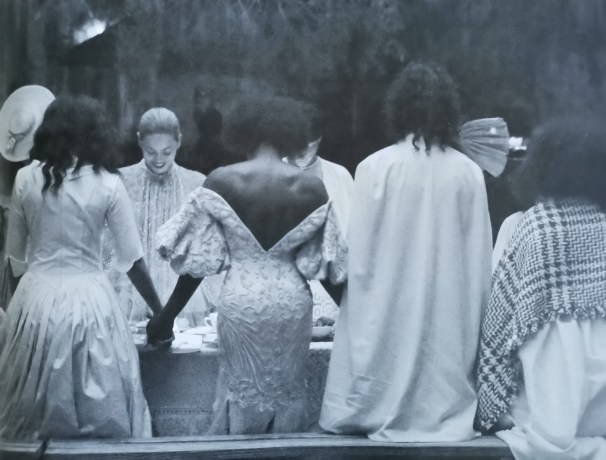
She underlines the link to America’s history of slavery with the line: ‘I break chains all by myself, won’t let my freedom rot in hell.’ This statement is even more so strengthened through the music video, where Beyoncé performs the song in front of a group of Afro-American women who dine at a table together, Beyoncé seemingly their matriarchal leader. In the background, you can see a southern plantation farm and recognise the characteristic southern live oak.

Here, Beyoncé connects the horrific past with a hopeful present. Because in the past slave owners would hang enslaved people on those very trees, but in the present, Afro-American women dine and celebrate underneath the seemingly protecting branches.
Beyoncé creates a powerful image. She reminds the viewer and listener of America’s horrible past yet wants to bring peace and healing through her voice and lyrics to this place, creating a new era together with other likeminded women.
Returning to Cowboy Carter and American Requiem, as mentioned, the last lines are more uplifting and hopeful, as is the rest of the song. In an almost comedic way, she tells the listener that this song and album will gain a lot of critics. She sings: ‘It’s a lot of chatter in here. But let me make myself clear.’ Not caring about her critics, she continues: ‘Can you hear me? Or do you fear me?’
The first question is, of course, mockery. Beyoncé has more than 315 million followers on Instagram and is the most decorated artist in Grammy history. When she speaks, (or sings) everyone listens, for she is American royalty.
Her second question, however, is a more serious one, where she almost self-reflects. She knows exactly that she talks and sings about things conservative and far-right politicians would like to deny and keep hidden in the past. But with her powerful, almost commanding voice, she reminds everyone that America is and has not been great at all, that this America needs to be buried and change must come.
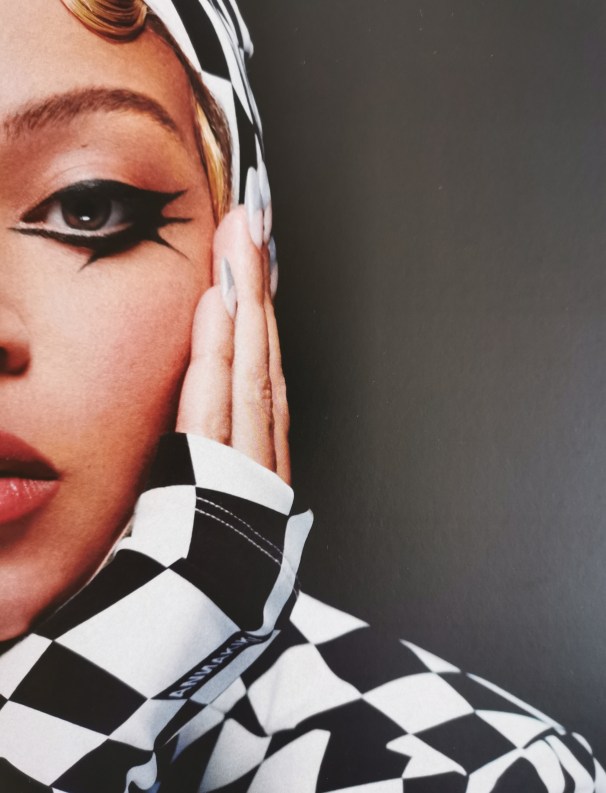
And this is very much the statement of the entire Cowboy Carter album. With its presence, Beyoncé factually states that American history is mostly a lie. She, a black woman, claims country music for herself again. Because, like so many other genres of American popular music, they have their origin and roots in Afro-American culture. The banjo, the most defining instrument in country music, was brought across the Atlantic from Africa to America via the slave trade. At the beginning of the 20th century, it was whitewashed as well as country music itself.
Country music is originally black, and Afro-American artists have been fighting since the beginning of the 20th century to be recognised again; however, they have mostly not been listened to as white Americans, especially conservatives in the South, have stolen this genre from them. It took over one hundred years for the biggest artist of our time, to remind America where country music comes from, and because of Beyoncé’s standing and influence, she could do it. By speaking out and speaking up like this, she has brought not only attention to herself but also to a lot of Afro-American country singers, some of which feature on her album.
Through her influence, she has given them a space to be recognised: Tanner Adell, Brittney Spencer, Shaboozey and Willie Jones are now much more visible within country music and the music world in general than before. But Beyoncé also looks back into the past and reminds listeners that black country singers have always been there, like Linda Martell, who also features on her album.
This process of stealing and reclaiming is, of course, not a singular incident regarding country music. Similar things can be said about house music or rock music and is part of Beyoncé’s discography. Cowboy Carter and country music is only the second instalment of a trilogy of reclaiming genres that have been whitewashed and taken from Afro-Americans.
And while a big part of Cowboy Carter is about music, another part is about cowboy history. A quarter of all cowboys in America’s Wild West were Afro-Americans. They took care of cattle, farms, and fields. The word cowboy itself derives from the act of a boy taking care of cows. And this boy, or these boys, were usually black men. Because, as this Beyoncé points out in her GQ interview of the October issue, you wouldn’t address a white man as a boy. It was black men, who were degraded as boys, who would take care and look after the cows on the fields of America’s Wild West. This is where the term cowboy comes from.

Bringing back all this critical history, Beyoncé created a lot of critics and enemies, but most of these people criticising her have been, perhaps not surprisingly, disliking her before, and have been openly racist. One radio station in Oklahoma (KYKC), for instance, refused to play Beyoncé’s country single Texas Hold’ Em because they argued that country music is white and that Beyoncé is not a country singer.
The Country Music Awards in the US also chose to take a racist stand when they refused to nominate any songs from Beyoncé’s country album. They argued that Beyoncé is not country enough, and that she has always been a mainstream singer. However, at the same time, they nominated Post Malone, who recently tapped into the country genre but is also not a country singer. Perhaps they nominated him because he is white and male.
And so, we return to Beyoncé’s question from the beginning: Can we stand for something? Can we leave the deeply problematic and dark past of America behind and finally take a stand? Well, Oklahoma and the American Country Music Awards have decided to remain in the past.
But what about Republicans and Democrats and the people who will vote in less than two weeks? It’s clear that Donald Trump is synonymous with racism and sexism. What he stands for, the old America, the ‘great America’ that needs to come back, the America Beyoncé has buried with her new album, he will try to resurrect come what may.
And what about Kamala Harris? What does she stand for? Does she stand for something? The answer is yes and no. While she couldn’t be more different from Donald Trump (but then again, this is not a hard thing to do and perhaps the most basic requirement when you want to be a politician to protect and affirm human rights), Harris remains problematic regarding a lot of issues inside and outside the United States of America.
One highly sensitive issue is gun control, and Harris stands against it. During her campaign, she has made it very clear that every American has the right to defend themselves and own a gun. While some Democrats and a lot of US citizens want more gun control, Harris is clearly on the conservative side here.
This stands in opposition to Beyoncé’s Lemonade album, as she clearly states in two songs and their music videos, (Forward and Formation) that there should be gun control, and in the Formation music video Beyoncé demands an end to gun violence and shootings in the US. Funnily enough, it’s from the very same album Harris picked her campaign song Freedom.
Another issue Harris stands undecided about is the genocide happening in Gaza. She clearly states that Israel has a right to defend itself, and as president she would continue to endorse and send weapons to Israel.
While Beyoncé and many other US celebrities have not directly spoken up about this war and genocide, one can surmise from recent political standpoints that Beyoncé would disagree with this cause of action as well. In her 2016 Superbowl performance and her 2018 Coachella performance, she made it clear that historically she stands with the Black Panther Movement.

And since the album Black is King and the song Black Parade, it is obvious that she stands with the Black Lives Matter movement. Back in the day, the black panthers have clearly stated that they stand with Palestine, and the Black Lives Matter movement has also made it clear that they stand against oppression and apartheid and stand with Palestine.
However, Harris is very clear on feminism and abortion rights. Here, she not only has the vocal support of many celebrities with influence like Beyoncé and Taylor Swift but also the popular opinion of an estimated 63 per-cent of all Americans demanding abortion rights.
Ultimately, when you have to choose one or the other, it is clear that Harris is the better candidate, regarding multiple issues. Trump embodies madness and chaos and sugarcoats this in his famous slogan: making America great again. However, it remains a fact that a lot of Americans appeal to his sexist and racist political stances, as they are themselves racist, sexist, and homophobic and want him to win the election.
And perhaps this is also the reason why Beyoncé decided to publicly endorse Kamala Harris in Houston, Texas, just ten days before the election. While there are a lot of problematic issues regarding Democrats, for a black woman in the US like Beyoncé herself, having always supported the Afro-American community as well as feminism, it is crystal clear that a second Trump presidency would be disastrous.
In her speech, she echoes pretty much everything she sings about in American Requiem. At the same time, she chose a more hopeful, a more energetic stance, as this was really about motivating people to vote, who might have issues with the Democrats regarding certain issues mentioned above:
It’s time to sing a new song. A song that began 248 years ago. The old notes of downfall, discord, despair no longer resonate. Our generations of loved ones before us are whispering a prophecy, a quest, a calling, an anthem. Our moment right now is a time for America to sing a new song. Our voices sing a chorus of unity. They sing a song of dignity and opportunity. Are y’all ready to add your voice to the new American song?
The speech pretty much heightens everything Beyoncé mentions in American Requiem, but this time clearly speaking to all Americans and the history they all share together. Her musical message couldn’t be clearer. The speech deeply repeats the final lines of American Requiem: Now is the time to face the wind, now ain’t the time to pretend, now is the time to let love in.
Beyoncé’s albums Cowboy Carter and Lemonade are both available on all streaming platforms.
The US election will take place on the 5th of November 2024.
 Fabian's Writing
One comment on “Can we stand for something?”