Halfway through the show, Beyoncé reminds her audience that she is the biggest, the largest force in the game. In the next interlude, a towering, larger-than-life Beyoncé (400-foot giant to be exact) rises from a swamp, shaking the earth beneath her as she strides toward a Southern town. She pours Sir Davis Whiskey into a water tank and keeps walking.
She reaches New York City, lighting a cigar with the flames of the Statue of Liberty, then crosses the Atlantic and arrives in Paris. A banjo begins to play as she returns to the U.S., walking through the Texan desert.

© Beyoncé, the visuals before TEXAS HOLD ‚EM. Beyoncé lights a cigar with the flames of Lady Liberty
Here, a group of white old cowboys gaze at her, mesmerised by her beauty and grandeur. She places a yellow glowing sign in the sand proclaiming: TEXAS HOLD ‘EM.
The first beats of Cowboy Carter’s lead singledrop. The crowd erupts. A truck rolls down a desert road. Neon lights flash. Cowboy boots sparkle. Caricatures of Beyoncé glow in yellow and red.
The giant stage opens. A silver-blue truck drives onto the scene, carrying Beyoncé and an army of background dancers seated on a built-in platform.
The crowd roars once again. Beyoncé smiles at her audience and asks: ‘Can I take y’all to Texas?’
The rodeo begins!
The fans don’t have to be asked twice. The music starts playing. Beyoncé begins to sing: ‘This ain’t Texas. Ain’t no hold ‘em. So lay your cards down, down, down, down.’ The fans start dancing and the rodeo is just getting started.

© Beyoncé, Beyoncé performs TEXAS HOLD ‚EM.
Sections three and four were all about celebrating the sonic experience of the Cowboy Carter album. Now, in section five, Beyoncé brings it home—not only performing her number one hit TEXAS HOLD ‘EM, but also transitioning seamlessly into Crazy in Love, her all-time party anthem. From there, she moves into Single Ladies, her biggest commercial success, followed by Love on Top, and finally Irreplaceable—or so it seems.
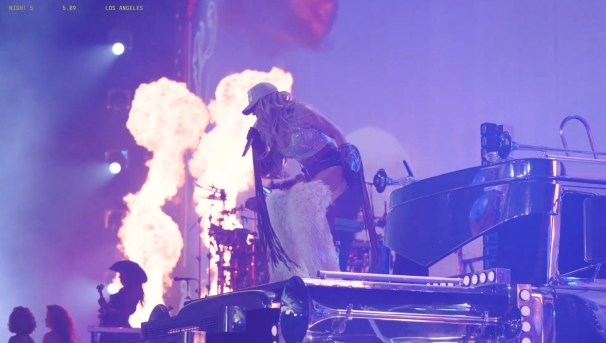
© Beyoncé, Beyoncé performs TEXAS HOLD ‚EM.
This part of the tour is a tribute to Beyoncé’s 28-year career and her chart-topping hits, shared in celebration with her fans. By this point, the crowd is so loud that Beyoncé pauses her performance to thank the fans who’ve supported her from the very beginning. She then wraps up the medley with one of her most powerful ballads: If I Were a Boy.

© Beyoncé, Beyoncé performs TEXAS HOLD ‚EM at her final night in London, wearing a Tina Turner shirt in honour of her greatest idol.
After celebrating her greatest hits, If I Were a Boy transitions into JOLENE, Dolly Parton’s iconic anthem that Beyoncé reimagined for Cowboy Carter. With that, the Chitlin’ Circuit returns, and Beyoncé dives back into tracks from her latest album.
But what exactly is the Chitlin’ Circuit, a term Beyoncé has mentioned several times throughout the show? The Cowboy Carter tour book offers a clear explanation:
‘Evolving from an irrepressible determination, a network of black touring agencies, venue owners, and musicians along the east coast and in the Midwest, but mostly concentrated in the south, established what became known as the Chitlin’ Circuit. Its cultural legacy is cemented in black entertainment careers spanning comedy, spoken word, dance and – of course – musical genres from country to blues to gospel to jazz and beyond. It’s no secret that the early twentieth century mainstream excluded black performers; and while they successfully shut us out, they failed to shut us up. Black imagination, community, and creative expression thrived autonomously in Houston’s Eldorado ballroom, Atlanta’s Royal Peacock, Memphis’ Club Handy, Detroit’s Paradise Theatre, and Chicago’s Club Delisa, among others in Louisiana, Alabama, DC, Baltimore, New York, Kentucky, and more. Cultivating the undeniable rise of many of music’s legends – Aretha Franklin, Big Mama Thornton, James Brown, Bessie Smith, Ray Charles, Tina Turner, Moms Mabley, Richard Pryor, and Redd Fox, to name a few – the Chitlin’ Circuit’s lasting impact is witnessed through the indominable influence of style that shaped – and still shapes – American music. The same southern hospitality and black ingenuity that sustained stages for black performance art, culture, and fellowship reverberates in the thoughtful and intentional design of your Cowboy Carter experience. It’s a triumph of the Chitlin’ Circuit’s trailblazing demonstration that we’re here tonight. Even if the world denies your art a space, may it never stifle your creative independence.’ (Beyoncé, Cowboy Carter Tour Book, pages 42 & 43)

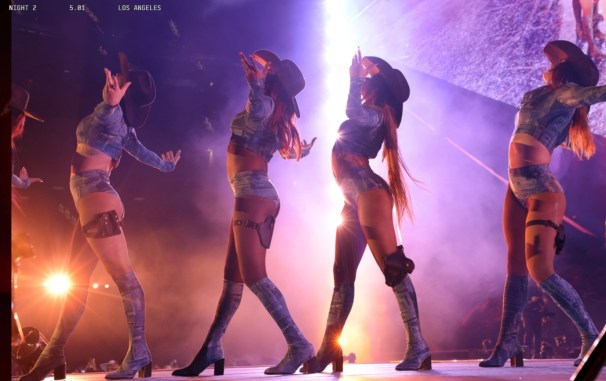
© Beyoncé, Beyoncé’s background dancers in cowboy looks
And it is in the spirit of the Chitlin’ Circuit that Beyoncé continues her concert. With her cover of JOLENE, she pays tribute to the past while also challenging the norms and restrictive roles women—especially Black women—have often been forced into and have long suffered under.
Dolly Parton’s Jolene, while undeniably beautiful and arguably one of the greatest songs of the 20th century, operates within a patriarchal binary: two women are pitted against each other over a man. One is portrayed as overtly sexual, trying to ‘steal’ someone else’s partner; the other, passive and pleading, begs Jolene not to take her man. She’s the ‘righteous’ woman, and therefore feels powerless to act—while Jolene, often branded a ‘slut’ simply for expressing desire, becomes the villain. The man, meanwhile, escapes scrutiny entirely, enjoying the attention of two women vying for his affection.
In Beyoncé’s version, she makes it unmistakably clear: if Jolene comes for her man, there will be consequences. Through her rewritten lyrics, Beyoncé flips the script—Jolene doesn’t succeed in seducing her partner because he doesn’t want to. He chooses to stay with Beyoncé, not out of obligation, but because she is his perfect match. And Jolene, Beyoncé implies, would do well to understand and respect that. ‘You’re beautiful beyond compare, Takes more than beauty and seductive stares to come between a family and a happy man… I raised that man, I raised his kids, I know my man better than he knows himself.’
However, the song takes on an entirely new dimension when paired with the visuals that precede it in one of the interludes. In this sequence, Beyoncé appears in drag as a male cowboy, being seduced by another version of herself—this time dressed in a highly sexualized outfit. She lassoes the cowboy version of herself, pulling him in.
In another scene, a different Beyoncé, again in provocative attire, appears onscreen—though it’s unclear who exactly she’s trying to seduce. Could it be that Beyoncé is, in fact, seducing Jolene? The question becomes all the more compelling when, in one of the rewritten lyrics, Beyoncé sings: ‘I’ma stand by her, she will stand by me, Jolene.’
Beyoncé leaves this aspect open to interpretation. Perhaps Jolene is trying to seduce Beyoncé’s man. But then again, in the visuals, Beyoncé is the man—and in another scene, she’s the one doing the seducing, possibly seducing Jolene herself.
What is clear is that Beyoncé refuses to conform. She plays with sex, gender, and desire—undermining the binary structures of patriarchy and having fun while doing it. And one thing is certain: no matter how you read the scene, you don’t mess with Beyoncé, because she sings: ‘I’m warning you, woman, find you your own man, Jolene, I know, I’ma queen, Jolene, I’m still a Creole banjee bitch from Louisianne.’
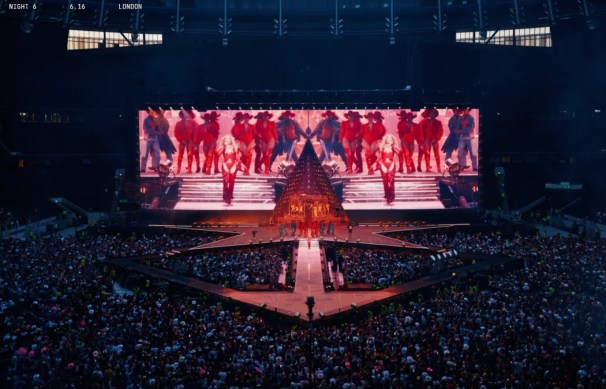
© Beyoncé, the entire stage during the performance
After JOLENE, Beyoncé launches into DADDY LESSONS—the very song that sparked direct experiences of racism back in 2017, ultimately inspiring the creation of Cowboy Carter.
For this part of the show, she takes a seat on a giant red-and-white glowing horseshoe, buckles up, and rises into the air—floating above the crowd and soaring through the stadium.
‘Can I get closer to y’all?’ she asks and the crowd cheers her on as thousands of people get to see her a lot closer. ‘This is the song that started it all,’ she says and the melody of DADDY LESSONS begins.

© Beyoncé, Beyoncé performs DADDY LESSONS on a giant horse shoe while flying over the stadium.
In 2017, Beyoncé performed DADDY LESSONS alongside the Dixie Chicks at the 50th Annual Country Music Association Awards. It was a powerful and moving performance—her first foray into country music, featured on her critically acclaimed, Grammy-winning album Lemonade.
However, not everyone in the predominantly white country music community welcomed her presence. Many, including prominent artists in the audience, reacted with outright rejection. According to insiders, racial slurs were openly spoken at the event. The online backlash was even worse, with waves of overtly racist comments flooding social media from those who refused to accept a Black woman claiming space within the country genre.
Alex Abad-Santos of Vox described the backlash: ‘Some of their sentiment was due to Beyoncé’s liberal-leaning politics, some of it was rooted in her perceived lack of country cred, and some of it was downright racist.’
Some country artists at the awards show dismissed Beyoncé’s performance, insisting that they didn’t need a pop star at their event—let alone nominated for an award—because, in their view, she ‘wasn’t country.’
Yet only a few years later, Post Malone—originally a hip-hop artist—ventured into country music and was warmly welcomed by the Country Music Association community, even earning nominations. Post Malone is a white man. Beyoncé is a Black woman. The structural and overt racism couldn’t be more blatant.
And yet, perhaps the Beyhive—and the music world at large—can almost say thank you to the Country Music Association Awards. Because it was this very experience that pushed Beyoncé to reconnect with her roots in Houston, Texas; to reflect on her ancestry and the history of African American culture—and ultimately to devote an entire album to country music.
A vital part of the Cowboy Carter album is its collaborations. Post Malone—who, as mentioned, has also ventured into country—joins Beyoncé on the track LEVII’S JEANS, singing a few lines alongside her. She also performs a duet, II MOST WANTED, with Miley Cyrus, Dolly Parton’s goddaughter.
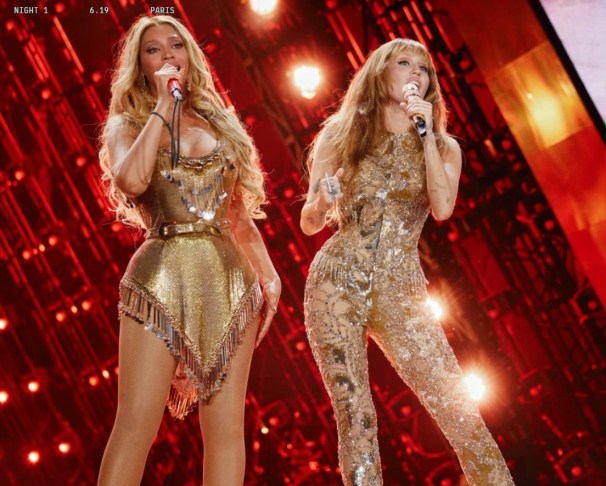
© Beyoncé, Beyoncé performs II MOST WANTED together with Miley Cyrus in Paris
In addition, Beyoncé is supported by country legends such as Dolly Parton herself and Willie Nelson, both of whom introduce tracks and appear in interludes throughout the album—bridging generations and genres.
But it’s especially young Black country artists who, like Beyoncé, have struggled to be accepted in a genre that remains overwhelmingly white. On Cowboy Carter, Beyoncé chose to collaborate with rising talents such as Tanner Adell, Brittney Spencer, Tiera Kennedy, Reyna Roberts, Shaboozey, and Willie Jones. She gives them space—and, more importantly, a voice—on her album, introducing them to a broader audience and showing her fans that there are many other Black country artists worth listening to and celebrating.
Much like her 2019 visual album The Lion King: The Gift, in which she collaborated with a wide range of African artists (mostly Nigerian and South African), Cowboy Carter is another powerful act of cultural uplift—this time shining a light on Black voices in country music.
Perhaps it comes as no surprise that the racism didn’t stop with DADDY LESSONS—it continued with Cowboy Carter. When Beyoncé released her lead single TEXAS HOLD ‘EM, the Oklahoma-based radio station 100.1 KYKC initially refused to play it, claiming that Beyoncé ‘wasn’t country’ and that country music was ‘white music’. After facing widespread criticism for their blatantly racist stance, the station reversed its decision and eventually added the song to its rotation.
Beyoncé has never made a public statement about the racist slurs and discriminatory decisions made by the music industry or the public. Instead, she wove her critique into the fabric of her country album and world tour. Lines like DESPITE THE NOISE WE SING and NEVER ASK PERMISSION FOR SOMETHING THAT ALREADY BELONGS TO YOU, both of which appear early in the show, take on even greater weight when viewed through this lens.

© Beyoncé, the tip of the stage
They resonate as powerful affirmations of resilience and self-determination—and they speak to the ongoing struggle against racism that Black Americans continue to face. These phrases also point to the deep roots of Black music and the long history of exclusion, reclaiming a space that has always, in truth, belonged to them. Once again, Beyoncé channels her anger, pain, and strength into her art—and lets the music speak for itself.
Michael Eric Dyson explains: ‘The moment Black folk were brought to America in chains, we shaped our environment through sound. Over the cruel centuries of slavery, we fought our brutal condition with song. We stretched our miseries across the necks of the banjos we created in the Caribbean and North America with an ear to Africa. We joyfully plucked our suffering into celebration. We sang work songs and field hollers as we made cotton king. We lifted our voices to the heavens to bravely face hell on earth by gathering in secret hush harbors to worship God. In grassroots churches we merged our jubilant voices in sorrow songs that haunt the culture to this day.’ (Cowboy Carter Tour Book, Keeping Our Music at Bey by Michael Eric Dyson, page 44)
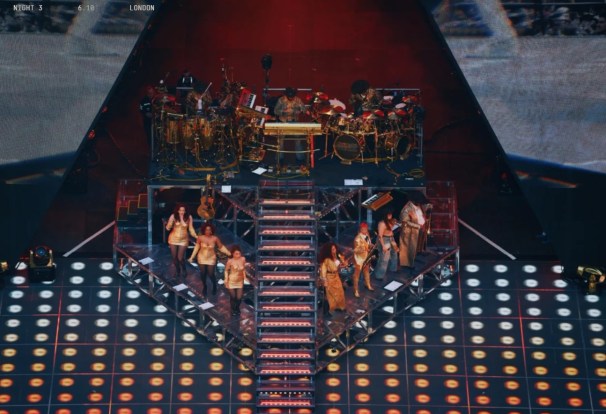
© Beyoncé, Musicians performing on the main stage.
And while some people remain stuck in the past, it’s encouraging to see that the majority have moved forward—embracing Cowboy Carter and Beyoncé for what they truly are: a phenomenal artist and a powerhouse of an album. Her success speaks for itself. TEXAS HOLD ‘EM became a number one hit in countless countries and stayed at the top of the charts for weeks. Cowboy Carter is yet another platinum-selling album in Beyoncé’s career and earned her the Grammy Award for Album of the Year, Best Country Album, and Best Duo/Group Performance for II MOST WANTED with Miley Cyrus. DESPITE THE NOISE WE SING.
After Beyoncé performs DADDY LESSONS—a deeply meaningful moment in the Cowboy Carter World Tour—she shifts genres once more. From country, she transitions into disco, then into hip-hop and R&B. In doing so, she once again reinforces the artistic vision behind Cowboy Carter and the broader narrative of her three-act journey.
You can mix the genres; you can play with music no matter where you come from. Music belongs to everybody and Beyoncé reflects this through her play with genres: ‘The music of the Black South samples a potpourri of influences and genres, a mélange of racial and ethnic roots. It is that richly resourceful Black South that shaped the musical appetite of Beyoncé. She heard the call-and-response of the blues. She imbibed the epic runs up and down the scale that marked both gospel and R&B. She heard jazz’s improvised polyrhythmic syncopation, from swing to bebop to hard bop. She felt the furious thump of funk. She heard the ethereal harmonies of neo soul and even the reborn rhythms of a resurgent disco. She heard the wondrous and creative lyricism of hip hop. And everywhere she turned in her splendid Southern sphere she heard the stories of pain and overcoming, of struggling and surviving, of pitiless introspection and drunken confession, as steel guitars wept while accompanying tear-stained regret.’ (Cowboy Carter Tour Book, Keeping Music at Bey by Michael Eric Dyson, page 45)
© Beyoncé, Beyoncé’s background dancers.
The sixth section of the Cowboy Carter World Tour centres around a single song: DAUGHTER. One of the most personal tracks on the album, it explores the idea that a daughter can be just like her father—a protector, and dangerous if necessary. The song challenges traditional narratives around infidelity and the ways women are threatened or diminished in relationships.
But Beyoncé also Beyoncéfies the song—just as she did with her reinterpretation of Jolene. She makes it clear: she is not passive, not harmless. You don’t want to cross her. She sings:‘I am colder than Titanic water.’
Furthermore, Beyoncé includes a passage from the Italian opera piece Caro mio ben, offering a striking showcase of her vocal range and technical skill. The choice is deliberate: the aria speaks of the loneliness caused by the absence of a loved one and the emotional cruelty a man can inflict on a woman—perfectly echoing the themes of DAUGHTER and deepening the song’s emotional resonance.
The sixth section may well be the most enchanting part of the show. The costume alone tells a powerful story, connecting Afro-American country heritage with the vulnerability of women living under patriarchy.
The extravagant gown with its dramatic shoulder pads evokes the iconic silhouettes of Southern dresses worn by women in the Wild West during the 19th and early 20th centuries. In this moment, Beyoncé becomes all of these women—giving voice and visibility to those who were long erased from history. Through the song and her commanding vocals, she channels the pain and oppression they likely endured in a male-dominated world.
But it’s not just the symbolism of the design that speaks volumes. This is also the most elaborate—and most expensive—costume Beyoncé or any pop star has ever worn on a world tour. The LED dress, created by the Japanese brand Anrealage and designed by Kunihiko Morinaga (with whom Beyoncé also collaborated on Renaissance tour costumes), is a stunning fusion of tradition and futuristic innovation.

© Beyoncé, Beyoncé in Anrealage
The dress is embedded with 35,000 full-colour LED lights, each individually programmed to shift and shimmer in real time with the music. The result is a living, breathing work of art—transforming Beyoncé’s body into a digital canvas.
Designer Kunihiko Morinaga, renowned for blending fashion with cutting-edge technology, rose to the challenge when Beyoncé requested a one-of-a-kind piece. He and his team spent weeks traveling between Tokyo and Los Angeles, meticulously crafting a performance-ready garment that honours the precision of Japanese craftsmanship while meeting the scale and spectacle required for a global superstar’s live stage.
At the heart of the design is Anrealage’s signature LED textile—a groundbreaking fabric that functions like a screen, capable of displaying real-time visuals across its surface. To bring this ambitious vision to life, Morinaga collaborated with Mplusplus, a Japanese firm known for pioneering the integration of lighting systems into textiles.
The wireless control system enables off-stage technicians to synchronize the LED visuals with the stage lighting and Beyoncé’s choreography in real time. The level of coordination required was extraordinary. The team carried out extensive rehearsals to ensure that the visual transitions on the dress aligned perfectly with the emotional arc of the music and the intricate lighting design of the show.
As Morinaga explains: ‘We enlarged the graphic elements of the LED design and made fine adjustments to brightness levels up until the final stages. Synchronization was everything.’
The fabric of the dress draws inspiration from the azekura—an ancient Japanese storehouse known for its breathability and distinctive architectural structure. This textile is specially engineered to block light from the front while allowing RGB light from the back to shine through, creating a mesmerizing, multidimensional optical effect.
This innovative design enables seamless visual transitions throughout Beyoncé’s performance: from tartan reds and blues to shimmering sequin textures, lace trompe-l’oeils, and cathedral-like stained glass patterns. Each visual motif serves a dual purpose—both as a fashion statement and as narrative symbolism, representing various facets of identity, femininity, power, and patriotism.

© Beyoncé, the dress transforms and so does the stage
At one point, the dress glows in the red, white, and blue of the American flag, before melting into monochrome and finally dissolving into a cosmic lightscape. As Morinaga describes: ‘It was like watching a star being born, live onstage.’
Beyoncé doesn’t just wear clothing—it is a visual symphony merging couture with code, elegance with electricity. And it took over a month and a half to bring it all together, from conception to final rehearsal.
“For us, this was more than a fashion piece—it was a cultural moment,” said Morinaga. “At Paris Fashion Week, what we presented was a glimpse into the future. But when Beyoncé wore it, it became the present. She turned it into a story, a performance, and a memory that will live on.”
And that’s the power of Beyoncé: she doesn’t just wear fashion—she transforms it. She turns visionary concepts into living, breathing moments on stage and etches them into pop culture history. Her collaboration with Anrealage is more than just a fusion of East and West, or tradition and technology—it’s a bold celebration of what fashion can become when led by imagination, artistry, and unapologetic ambition.
In a world where live performances are often forgotten the moment the final note fades, Beyoncé’s LED dress ensured that this one would be remembered—etched not just in memory, but in light. (Levelup.com, Fashion Section, by Ellora Cummins)
The seventh section takes the audience back to the summer of 2023. It marks the only departure from the Cowboy Carter album and its themes, offering a brief but powerful shift—from the reimagined, self-defined America Beyoncé built through Cowboy Carter to the liberating universe of Renaissance. Here, the safe space remains intact—just transformed: No one is judged. Everyone is free.

© Beyoncé, Beyoncé welcomes the audience to the Renaissance
The visuals are unapologetically cunty—but this time, they shimmer in gold instead of silver. Kevin JZ Prodigy’s voice echoes through the stadium, inviting the audience into ‘mother’s mind… the house of the Reneneneneneneaissance!’ As the beat of I’M THAT GIRL begins to pulse, the pride flag fills the screens, followed by images of Tina Knowles and Uncle Johnny—deeply personal nods to Beyoncé’s roots and family history.
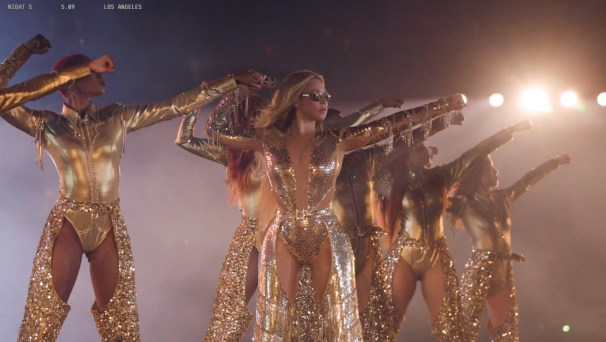
© Beyoncé, Beyoncé performs I’M THAT GIRL
The stage gates open. Beyoncé sits atop a golden horse, her body encased in golden armour, which is then dramatically removed by a robot. She steps forward, radiant, and greets the crowd: ‘Welcome back to the Renaissance!’
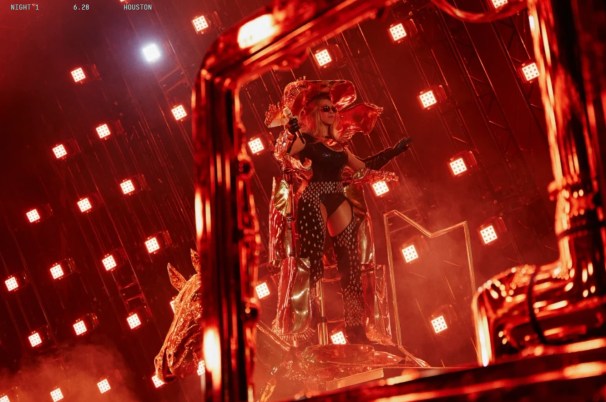
© Beyoncé, Beyoncé stands on a golden horse and is freed from golden armour, ready to perform the Renaissance songs.
This section mirrors the second section of the Renaissance World Tour, reprising its signature energy. I’M THAT GIRL leads into COZY, followed by ALIEN SUPERSTAR. During select shows—particularly in London—Beyoncé added ENERGY (complete with the iconic mute challenge) and BREAK MY SOUL, electrifying the crowd once more with the bold spirit of Renaissance.
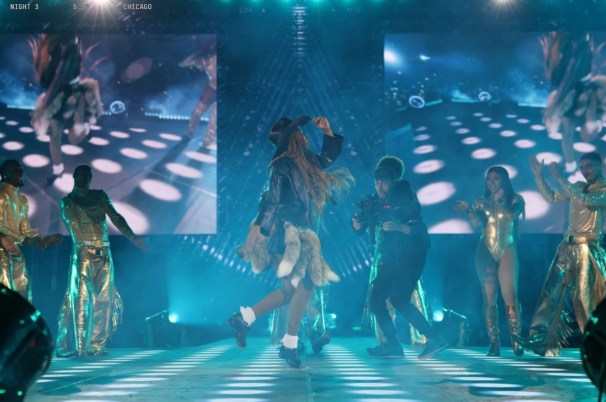
© Beyoncé, Beyoncé’s background dancers take centre stage and turn the stage into a ballroom and start voguing.
The next part delivers one of the most iconic moments of the show: Beyoncé steps back and gives the spotlight to her background dancers—most notably the legendary Honey Balenciaga—who take centre stage to vogue and transform the arena into a full-on ballroom. For a few electric minutes, the energy shifts, and the concert becomes a celebration of queer culture, house music, and ballroom excellence. If you’re looking to revisit the Renaissance era in more depth, you might want to check out this 2023 opinion piece: Welcome to the Renaissance! – Fabian’s Writing
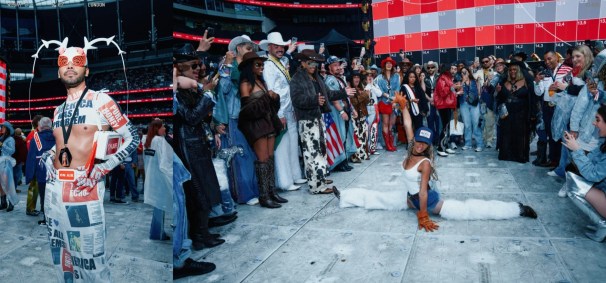
© Beyoncé, the fans know the spirit of the Renaissance. In anticipation of the show, the fans vogue and dance while waiting for the show to start.
After the background dancers have their moment in the spotlight, Blue Ivy takes centre stage for a solo dance performance. She delivers a confident choreography to one of her parents’ most iconic tracks: Déjà Vu—a standout from Beyoncé’s 2006 B’Day album, featuring Jay-Z.
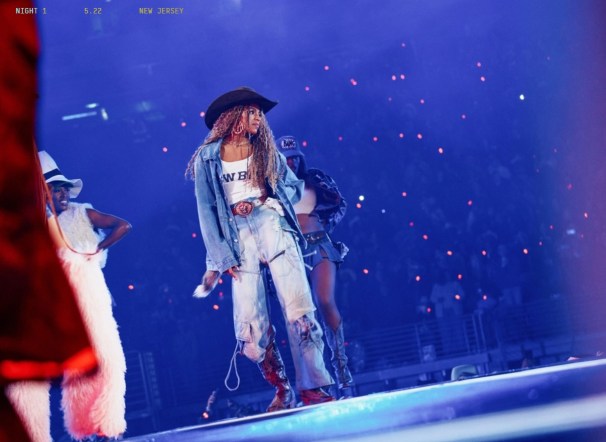
© Beyoncé, Blue Ivy dancing
And then, after nearly three hours of breathtaking visuals, soul-stirring vocals, layered political and social commentary, seven costume changes, and countless iconic moments—including Beyoncé riding a golden mechanical bull while performing TYRANT—the final interlude begins. It marks the beginning of the last section, bringing Cowboy Carter and the Rodeo Chitlin’ Circuit World Tour to a powerful close.

© Beyoncé
Videos and images from Beyoncé’s childhood begin to flash across the screens—her early singing competitions, the first steps with Destiny’s Child, and the rise of her solo career, from Dangerously in Love to I Am… Sasha Fierce, all the way through Lemonade and Renaissance. Then comes the moment so many had long awaited: Beyoncé finally winning the Grammy for Album of the Year.
In a matter of seconds, image after image of Beyoncé’s face flickers across the stage—28 years of music, performance, reinvention, and impact condensed into a single, breathtaking montage. She is not just an icon; she is the defining face of America’s music industry and sonic evolution.

© Beyoncé
No artist has shaped, transformed, and transcended music the way Beyoncé has since 1997. And she’s been country since the very beginning—reclaiming its roots, opening its gates, and inviting the world to rediscover the genre’s depth, soul, and beauty.
Marissa R. Moss explains this in ‘Beyoncé reshapes a Tradition for the Future’: ‘Truth is, I always had a feeling that Beyoncé was one of us- that not only did she never look down on country music or country culture, but she knew that this music was more than something low-brow or guilty pleasure, or something city folk couldn’t relate to. You could tell from the cowboy hats back in Destiny’s Child days, you could tell by the horse she road in on to perform at Houston Rodeo, you could tell by the stories she told in her music. Most importantly, you could tell because when someone is an artist at that level, they go looking for art everywhere. Beyoncé knew there was art in country music, and that there was beauty. And now the world will know. This does not mean that the genre of country music is perfect – far from it. The genre has spent its existence trying to define who gets to like country music, or who gets to participate, to keep it securely in the hands of mostly white men and a white audience. But as Beyoncé said, this is not a country album. This is a Beyoncé album. We can listen and learn based in what it sounds like, not what box it exits in. We can ask, what songs we have missed because we dismissed a whole type of music? What artists did we never give a chance? There has always been a disconnect between the genre of country music and the music itself – between the marketing, and the magic. It’s made anything but country music an acceptable posture, and it’s made ignorance about an entire musical body somehow defensible. It’s something country fans, and country artists, have learned to deal with. It’s a sad way to live with art. The tide has shifted with Cowboy Carter, from those first notes of the banjo on TEXAS HOLD ‘EM to every line dance it has inspired and well beyond. Here is a most vital voice in music inhabiting the sound but not the genre, tugging and reclaiming its roots. In her hands, country music is not just cool, but something deserving of true critical appreciation, and as fun and liberating as pop when done right. Because everything Beyoncé does is art, country music can be seen as art. How validating it’s been to think I may no longer have to fight against the anything but country music crowd! How lucky we are to collectively enjoy these songs as a culture, and reshape a tradition for the future. How freeing it is to come out of that darkness.’ (Marissa R. Moss, Cowboy Carter Tour Book, pages 85&86)
For a moment, the stage and screens go completely dark. Then, the carousel and 16 carriages appear—glowing gold against the blackness. The warm melody begins to play, and golden light bathes the stadium in a welcoming, cinematic glow.

© Beyoncé
From the centre of the stage, Beyoncé rises in a red Cadillac, dressed in a glittering silver, white, red, and blue bodysuit by Loewe—a look that blends patriotism with pop iconography, stage glam with symbolic power. She begins to sing 16 CARRIAGES—the song that captures the essence of her journey: the relentless work, the personal sacrifices, the losses carried silently, and the victories that, in the context of the Cowboy Carter World Tour, shine more brilliantly than ever before.
She glides above the crowd—originally in the Cadillac, though since Atlanta she has ridden a golden horse due to a technical malfunction in Houston—bringing herself one last time closer to the fans who have followed her through decades of reinvention and revolution.

© Beyoncé
But Beyoncé has one more song for her fans. Back on stage, the melody of AMERIICAN REQUIEM begins once more. The Cowboy Carter Tour—and the journey it represents—comes full circle. This is not just an encore; it’s a final statement.
Her army of background dancers returns for one last appearance, now dressed in striking black suits, their capes made from the American flag. The symbolism is unmistakable: a reimagining of what America can be— diverse, and unapologetically welcoming.
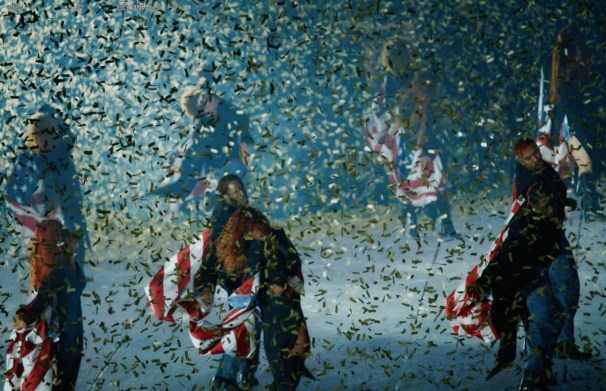
© Beyoncé, the background dancers perform the final song
As Beyoncé sings, the performance becomes a requiem, a celebration, and a revolution all at once. And with that, the curtain falls—not just on a concert, but on a cultural milestone.
‘Listen carefully to the sound of a child whose father was an original foothold in the integration of Litchfield Junior High School in Gadsen, Alabama; whose mother maintained the Afro-Creole traditions of her Louisiana foremothers in building her own future in Galveston, Texas. Her early childhood was wrapped in the profound impact of Southern culture heritage, especially music, art, food, and folklore. From beauty pageants in fluffy, glitzy gowns to nights at the Zydeco, the sights, sounds, and feelings of country culture nurtured her. The attested pride heard in YAYA and the reimagined OH LOUISIANA shaped the attitude that confidently donned a cowboy hat in the Destiny’s Child video for Bug a Boo, when a rise in early criticisms of a girl who spoke too country were circulating. Understand country as something greater than a genre that has been mostly gatekept by white radio. Country is a complex legacy so deeply woven into the fabric of this grandbaby of a moonshine man that no matter how often or far she travels, there’s a lil Linda Martell, Queen Ida Guillory, and Ruby Falls in the air of her walk. After all, you can take the girl out of the country music, but you can’t touch the country in her.’ (Beyoncé, The Cowboy Carter Tour Book, page 16)
Beyoncé begins to sing the final track of the Cowboy Carter album—which is also the last song of her world tour: AMEN. And perhaps there is no better word to define a show like this. Truly, it has been one of a kind.
But it’s the lyrics that deliver the final testament to what the Cowboy Carter and the Rodeo Chitlin’ Circuit World Tour truly stand for: a reclamation of identity, a rewriting of history, and a celebration of freedom, resilience, and belonging: ‘This house was built on blood and bone, and it crumbled, yes, it crumbled. The statues they made were beautiful. But they were lies of stone. Trumpets blare with silent sound. I need to make you proud. Tell me, can you hear me now?’
With the final line, Beyoncé circles back to the question she asked at the very beginning—in the lyrics of AMERIICAN REQUIEM: ‘Can you hear me?’
Yes, Beyoncé. We can hear you now.
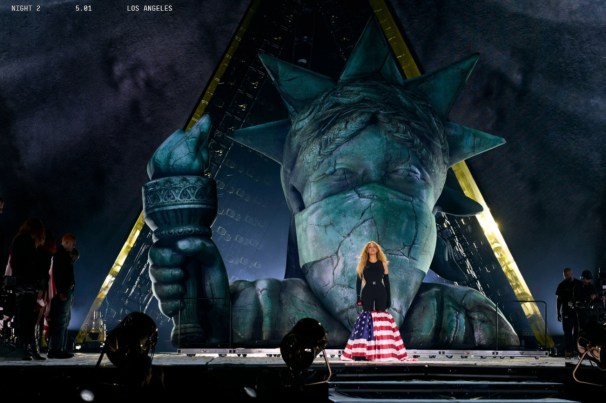
© Beyoncé
At the centre of the stage, the Statue of Liberty appears. Her appearance, Lady Liberty, reminds the audience that America has always been a country of immigrants. But there is more: her face is wrapped in a bandana, referencing Black culture and the Black Lives Matter movement as well as the gangs of America, underlining the fight against structural injustices. It is the show’s final visual: a powerful, defiant symbol of liberation, resistance, and redefinition.
The Cowboy Carter and Rodeo Chitlin’ Circuit World Tour is not just a concert—it’s a cultural reckoning. A demonstrative statement wrapped in music, art, fashion, and layered symbolism. A fearless confrontation of injustice. A celebration of legacy. And above all, it marks what may be Beyoncé’s most potent, most personal, and most beautiful era yet.
And the fight continues—and will continue. Because back in the 1960s, Paul McCartney’s Blackbird didn’t change the world. It didn’t change the minds of racists. And the Cowboy Carter album, nor its accompanying World Tour, will change the mind of Donald Trump or his MAGA followers either.
Music and art alone don’t change the world. Beyoncé knows this. But she also knows that DESPITE THE NOISE WE SING. Because art can be a weapon. A voice. A mirror. A spark. It can be part of the fight for human rights, part of showing up, part of participating. Time and progress can change minds.

© Beyoncé
Much has changed since the 1960s. Even more has changed since the cowboy era of the 19th century. And things have changed since Beyoncé rose from the lead singer of Destiny’s Child to the defining superstar of the 21st century. And still—she sings.
And in the face of all this noise, Beyoncé creates her own noise—her own melody, one powerful enough to echo louder than the hatred, louder than the misinformation, louder than the self-interest of politicians, racist institutions, and world governments. Through that sound—through music, movement, and message—she carves out safe spaces. Spaces for those who have long been pushed to the margins. Spaces for anyone who dares to saddle up and join the rodeo. Because everyone who wants to take a ride is welcome.

© Beyoncé
In the words of Beyoncé: ‘Act II is no longer mine. It now belongs to whomever it inspires, whomever it heals, whomever it sparks curiosity in, whomever it annoys. Ha! To all the legends that came before me and opened the door for me, my prayer is that this album does the same for the next generations to come and continues to open minds, break down barriers and open doors that have remained closed for far too long.’ (Beyoncé on her Cowboy Carter Album)
Can you hear Beyoncé now? Yes, we can hear her. The only question remaining, are you ready for Act III?

© Beyoncé, Beyoncé at the end of her show.
More opinion pieces on Beyoncé:
Can we stand for something? – Fabian’s Writing
Welcome to the Renaissance! – Fabian’s Writing
The Art of Beyoncé – Fabian’s Writing
Sources:
americansongwriter.com
Beyoncé.com
Cowboy Carter Tour Book
Genius.com (lyrics)
GQ Interview with Paul McCartney
Levelup Online Magazine
Rollingstones.com
 Fabian's Writing
Habe teil 1 gelesen, unglaublich gut analysiert, gedacht, geschrieben und bebildertâ¦
Sollte man mehr daraus machenâ¦
papa
Gerhard Sindelar, CEO
beyondarts GmbH Untere Ãden 32 | 3400 Klosterneuburg | Ãsterreich
M +43 699 11 04 35 46
office@beyondcom.at office@beyondcom.at
https://beyondcom.at/ https://beyondcom.at
https://beyondcom.at/
LikeLike
What an epic breakdown of the Cowboy Carter tour! 🤠 I love how you highlighted the „Chitlin’ Circuit“—that history of resilience and black ingenuity is so powerful. That 400-foot giant visual sounds like a total „Beyoncé move“!
Also, 35,000 LEDs on one dress? Pure magic! 🤩 It’s incredible how she uses fashion to reclaim her roots while calling out the industry’s gatekeeping. Reimagining Jolene to flip the script was a genius touch, too. Thanks for such a deep dive into this cultural masterpiece. Queen Bey really is in a league of her own!
LikeGefällt 1 Person